
Thanks for your interest!
Simply fill out the form below and one of our team
will be in touch shortly
News
19 Jun 2026

In this article, we explore the impact of the Climate Stripes and why effective climate communication is essential in driving awareness and action on climate change
Show Your Stripes Day is an annual opportunity to raise awareness of climate change through one of the most powerful and recognisable visualisations ever created: the Climate Stripes.
Over the years, climate scientists have developed thousands of graphs, charts and illustrations to communicate the scale and speed of climate change. Yet few have resonated with the public as effectively as the Climate Stripes. Their simplicity and accessibility have made them a globally recognised symbol of our changing climate, and one of the defining symbols of climate change communication around the world.
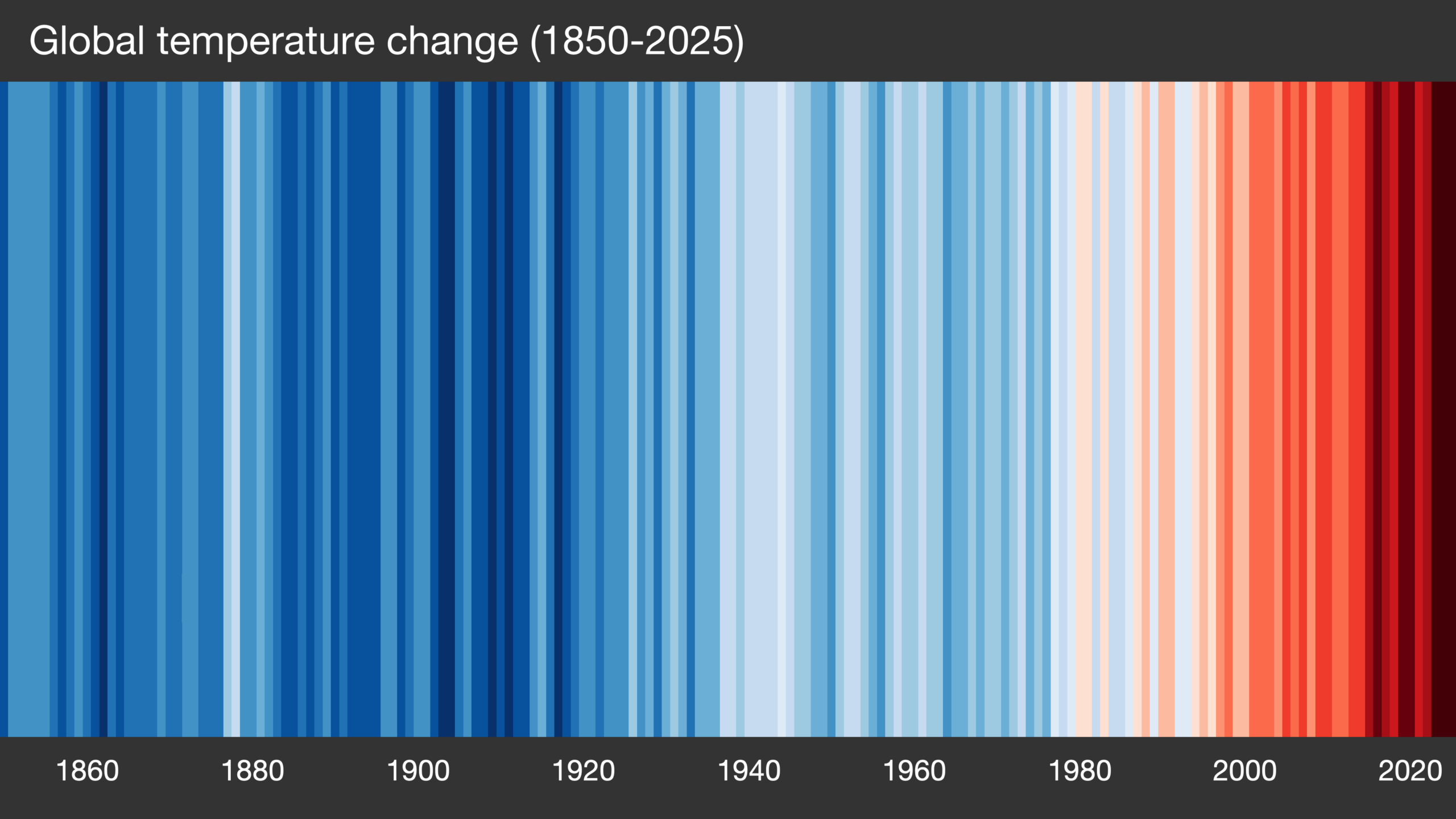
(image courtesy of Professor Ed Hawkins (University of Reading) at https://showyourstripes.info/)
The success of the Climate Stripes has been truly remarkable. What began as a scientific visualisation has become the image representing global action on climate change; appearing on clothing, artwork, sporting events, public buildings and some of the world’s most iconic landmarks.
The concept itself is elegantly simple. Each stripe represents a year, with colours illustrating how that year’s average temperature compares with the long-term historical average. Cooler-than-average years are shown in shades of blue, while warmer-than-average years appear in shades of red. As the timeline progresses, the transition from predominantly blue stripes to increasingly deep reds tell a compelling story without the need for numbers, graphs or technical explanations.
What becomes immediately apparent when viewing the stripes for any region, country or city is the clear and accelerating warming trend. Unlike traditional climate charts, which can sometimes appear complex or intimidating, the Climate Stripes communicate their message instantly. In a matter of seconds, anyone can recognise the pattern and understand that something significant is happening.
Perhaps the greatest achievement of the Climate Stripes is the ability to transcend scientific knowledge. You do not need to be a climate scientist, or even have a detailed understanding of climate change, to recognise the trend. The visualisation makes it easy to see that we are living in a period of unprecedented warming and that the climate we experience today is already different from that experienced by previous generations.
The Climate Stripes provide a powerful reminder of the challenge facing us all. They encourage us to recognise both the reality of climate change and the importance of accelerating efforts to reduce greenhouse gas emissions. By making complex climate data understandable and accessible, they help connect people, communities, organisations and nations around a shared understanding of the need for action.
We encourage everyone to visit the Show Your Stripes website and explore the visualisations available for different countries, regions and cities. You can view data for locations close to home and see how temperatures have changed over time in your own area, making the impacts of climate change even more tangible and relevant.

In this article we explore how the Climate Stripes have become one of the most recognisable and accessible symbols of climate change communication.
The simple visual format helps make complex climate data easier to understand, raising awareness and encouraging action to reduce greenhouse gas emissions.