
Thanks for your interest!
Simply fill out the form below and one of our team
will be in touch shortly
Resource
25 Jun 2026

The Energy Savings Opportunity Scheme, known as ESOS, is a mandatory UK energy assessment scheme for large organisations. It requires qualifying organisations to measure and assess the energy used by their buildings, industrial processes and transport, and to identify energy efficiency measures that could help reduce energy use, costs and carbon emissions. For many organisations, the introduction of the ESOS action plan has changed the way compliance is approached.
ESOS compliance is no longer only about completing an audit and submitting a notification. It is now also about setting out how your organisation intends to act on identified energy-saving opportunities, monitor progress and demonstrate accountability over time.
Handled well, an ESOS action plan can become more than a regulatory document. It can help large organisations prioritise energy efficiency measures, reduce operational costs, improve data quality and create a clearer route towards long-term carbon reduction.
An ESOS action plan is a document that sets out the steps an organisation intends to take following its ESOS assessment. The action plan should also include the expected implementation dates, whether the actions were recommended through ESOS, the estimated savings over the four-year action plan period and the method used to estimate those savings.
This requirement was introduced for ESOS Phase 3, increasing the focus on practical delivery rather than assessment alone. The aim is to encourage organisations to act on the opportunities identified through their ESOS audits and make energy efficiency a more active part of business planning.
For organisations with complex estates, multiple sites, industrial processes or high energy usage, ESOS action plans can provide a useful bridge between compliance, cost control and operational improvement.
ESOS has always been designed to help large organisations understand energy consumption and identify efficiency opportunities. It offers a way of providing tailored and cost-effective recommendations on energy efficiency measures, helping participating businesses save energy and achieve carbon and cost savings.
A strong ESOS action plan helps turn recommendations into practical next steps. It can support better internal accountability by making it clearer which actions are being considered, when they may be implemented and what level of savings they could deliver.
This is particularly important as organisations prepare for ESOS Phase 4. The confirmed Phase 4 compliance period runs from 6 December 2023 to 5 December 2027, with a qualification date of 31 December 2026 and a compliance deadline of 5 December 2027.
By using the Phase 3 action planning period to improve data quality, track progress and prioritise improvements, organisations can put themselves in a stronger position before the next ESOS deadline.
For organisations that qualified for ESOS Phase 3, the action plan and progress update requirements are an important part of the compliance timetable. The Phase 3 action plan was due by 5 December 2024, with annual progress updates due on 5 December 2025 and 5 December 2026.
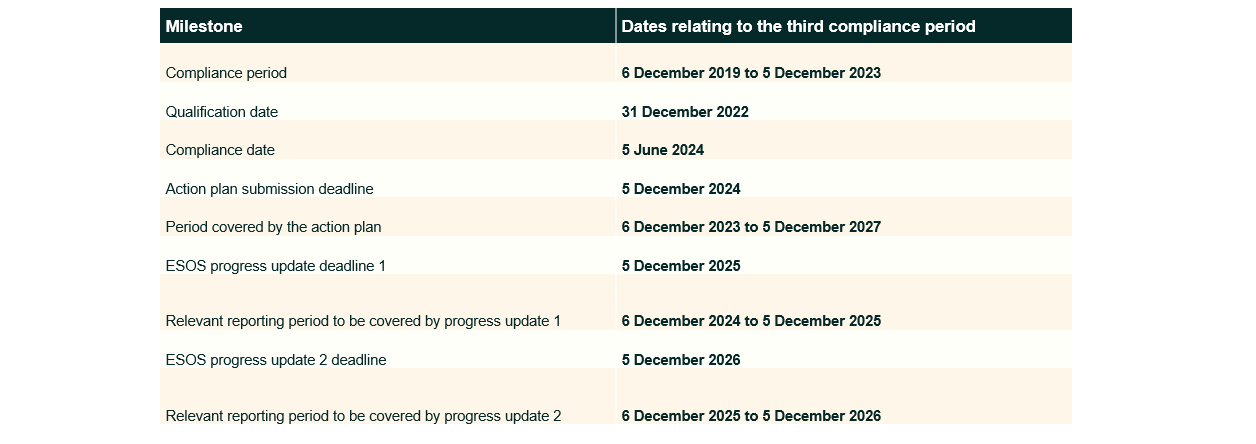
These dates show why ESOS action plans should not be treated as one-off submissions. The action plan covers the four years following the compliance period, which coincides with the subsequent compliance period. For the third compliance period, this means the action plan covers 6 December 2023 to 5 December 2027.
ESOS Phase 3 introduced a stronger focus on action planning and progress reporting. ESOS Phase 4 continues the move towards greater accountability, with organisations expected to prepare for the next compliance deadline while maintaining better energy data and evidence.
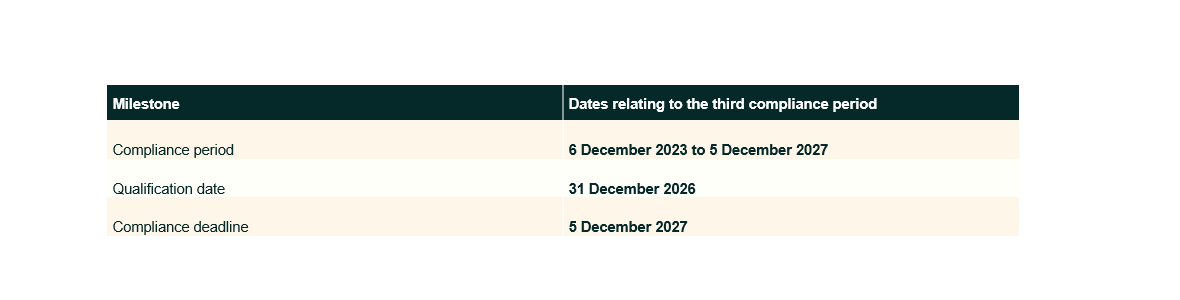
The Phase 3 action plan period overlaps with the Phase 4 compliance period. This creates an opportunity to use current action planning activity to support future reporting. For example, if your organisation is already tracking energy-saving measures, reviewing savings estimates and maintaining an evidence pack, that work may also improve readiness for the next ESOS assessment.
Organisations that connect Phase 3 action planning with Phase 4 preparation may be better placed to reduce duplication, improve governance and make energy efficiency decisions based on better evidence.
A practical ESOS action plan should be clear, evidence-based and realistic. It should avoid vague commitments and instead set out actions that can be monitored over time.
Typical information includes:
This makes the action plan a useful internal management tool as well as a compliance document. It can help teams understand what has been committed, what remains under consideration and where further analysis may be needed.
The real value of ESOS comes from acting on the opportunities identified through the assessment process. This is where compliance can support energy optimisation.
For many organisations, recommendations may include a mix of no-cost, low-cost and capital investment measures. These could relate to heating, ventilation and air conditioning, lighting, controls, building fabric, metering, process efficiency, renewable energy, behavioural change or improved energy management.
A practical approach is to group recommendations by impact, cost, complexity and likely return. This helps decision-makers prioritise quick wins while planning larger projects around maintenance cycles, budget availability or wider estate investment.
This is also a useful point to consider how to reduce energy consumption in business in a structured way. Rather than focusing only on individual projects, organisations should look at how energy is used across sites, assets, operating hours and business activities. Better visibility can help identify where waste occurs and where investment could deliver the strongest return.
ESOS sits within a wider energy and carbon management landscape. The data gathered for ESOS can support other reporting and planning activities, including carbon footprinting, SECR, Scope 1, Scope 2 and relevant Scope 3 emissions, and net zero planning.
For example, an ESOS assessment may help identify where direct fuel consumption, purchased electricity or transport activity are contributing to overall emissions. This can support a more complete view of energy and carbon performance, especially when combined with wider reporting frameworks and carbon reduction planning.
This is where energy management solutions can play a useful role. By improving data collection, reporting processes and visibility across an estate, organisations can make more informed decisions about procurement, building performance, carbon reduction and future investment.
For organisations seeking clarity on how to reduce energy consumption in business, ESOS provides a structured starting point. The assessment identifies where significant energy is being used and where savings may be available. The action plan then helps move those opportunities into a clearer implementation pathway.
A practical process could include:
Organisations can face several challenges when moving from assessment to implementation. One common issue is data quality. If consumption data is incomplete, inconsistent or held across different systems, it can be difficult to estimate savings and track progress with confidence.
Another challenge is internal ownership. Energy efficiency often touches finance, estates, operations, procurement and sustainability teams. Without clear responsibility, even valuable recommendations may stall.
Budget planning can also be difficult. Some measures may have a clear return on investment but still require capital approval. Others may be best delivered alongside planned works, rather than as standalone projects.
This is why energy optimisation should be seen as an ongoing process rather than a single compliance exercise. The most effective organisations use ESOS to improve visibility, strengthen governance and embed energy performance into broader decision-making.
We support organisations with ESOS compliance, energy assessments and practical efficiency recommendations that help turn regulatory requirements into useful business insight.
Our ESOS service can help you understand whether your organisation qualifies, we can then calculate total energy consumption, identify areas of significant energy use, complete required audits, prepare the ESOS notification of compliance and maintain the evidence needed to support your submission.
Our lead assessors and energy specialists can also support the preparation of your ESOS action plan and annual progress updates, helping you create a clearer link between compliance, implementation and measurable improvement.
For organisations preparing for Phase 4, this support can help reduce administrative pressure, improve confidence in reporting and identify practical opportunities to reduce consumption, cost and carbon.
An ESOS action plan should not sit on a shelf until the next deadline. It should help your organisation understand what can be improved, what should be prioritised and how energy-saving activity can be tracked over time.
By approaching ESOS as part of a wider energy strategy, organisations can move from reactive compliance to proactive performance improvement. This can support better cost control, stronger reporting, clearer governance and a more practical route towards long-term sustainability goals.
To learn more, explore our ESOS service or get in touch for further guidance on energy compliance.
An ESOS action plan sets out the energy-saving actions an organisation intends to take following its ESOS assessment. It includes planned measures, expected timescales, estimated savings and how those savings have been calculated.
Introduced in ESOS Phase 3, qualifying organisations were required to submit an action plan after the compliance notification. They must also submit annual progress updates for the following two years.
An ESOS report or assessment helps identify energy consumption and saving opportunities. The action plan sets out what the organisation intends to do in response to those findings.
ESOS can support energy optimisation by identifying where energy is being used, where waste may exist and which measures could reduce consumption. The action plan then helps prioritise and track those measures.
We can support the full ESOS process, including qualification checks, data collection, audits, lead assessor support, action planning, progress updates and practical recommendations for improving energy efficiency.