Thanks for your interest!
Simply fill out the form below and one of our team
will be in touch shortly
Resource
25 Sep 2026

Choosing renewable electricity affects energy costs, contract governance, carbon data and the evidence available for Streamlined Energy and Carbon Reporting (SECR). For organisations comparing green energy tariffs UK with onsite generation, the right route depends on operational needs, site suitability, funding and sustainability objectives.
The strongest approach connects procurement, energy management and carbon reporting from the outset. That helps finance, estates, procurement and sustainability teams make one coordinated decision and retain the information needed to support future disclosures.
A supplier-backed green tariff provides electricity through an energy supply contract selected against consumption, budget, risk tolerance and environmental goals. Onsite generation produces electricity at the organisation’s premises, most commonly through solar PV. It can be capital-funded or delivered through a Power Purchase Agreement (PPA), under which a third party designs, installs, owns and operates the system.
Compare the whole commercial and reporting arrangement, including contract duration, demand, generation potential, funding, imports, exports and carbon-reporting evidence.
Supplier-backed green electricity: Organisations assessing green energy tariffs UK continue to buy electricity through an energy supply contract. Our Energy Procurement service assesses fixed, flexible and green energy options against consumption, budget requirements, risk tolerance, market conditions and environmental goals. It also provides supplier comparisons and risk assessments to support informed decision-making.
Searching for green energy providers UK may produce many choices, but price should not be the only consideration. Contract terms, service, evidence and alignment with the organisation’s sustainability strategy also matter.
Onsite generation: Onsite solar PV can reduce reliance on grid-imported electricity and support net zero objectives. Zenergi provides an end-to-end Solar PV service covering feasibility, design, construction, project management and handover.
Where capital investment is a barrier, a Power Purchase Agreement can provide onsite low-carbon technology without upfront capital. Our solution typically runs for 10–25 years, with electricity purchased at an agreed p/kWh rate and maintenance, repairs and remote monitoring included.
The following summary synthesises the decision factors presented across our procurement, Solar PV, PPA and SECR services.
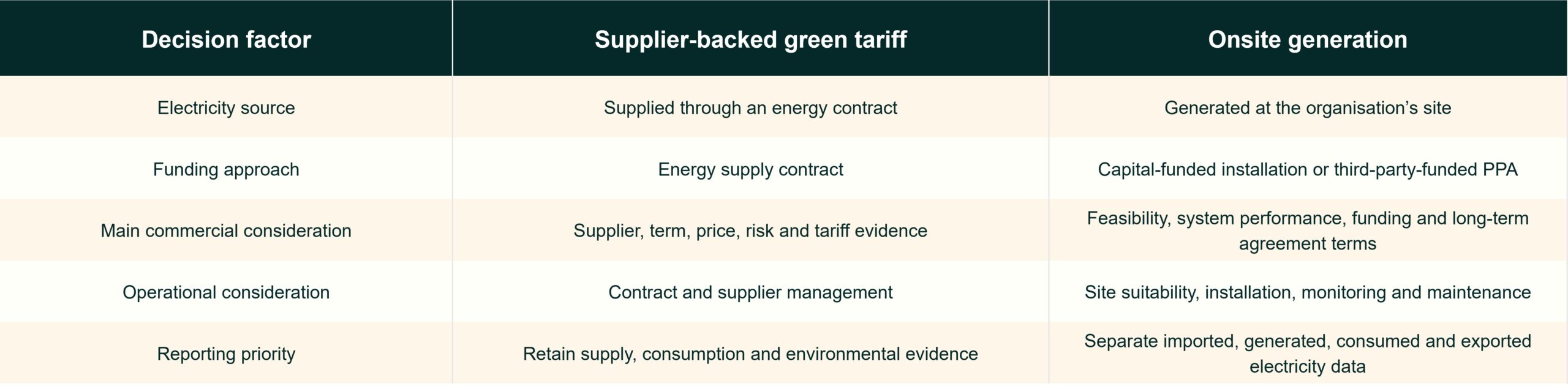
When reviewing green energy tariffs UK, procurement teams should require clear documentation, particularly where the contract will inform carbon reporting, a net zero plan or environmental communications.
Before appointing a supplier, verify:
A search for green energy providers UK should lead to a structured comparison, not a decision based on headline price or environmental language. Zenergi can assess suppliers, contract duration and procurement options against consumption, governance and sustainability requirements.
Solar feasibility should come before assumptions about generation or savings. Zenergi can estimate system size, energy generation, installation costs, carbon savings, payback and lifetime carbon savings, creating a stronger basis for choosing capital-funded Solar PV or a PPA.
Compare expected generation with demand. Electricity used onsite can reduce grid imports. Where generation may exceed demand, investigate an appropriate solar export tariff alongside the wider business case.
Review a solar power export tariff for eligibility, pricing, duration, metering requirements and export records. Assess export income alongside system performance, onsite consumption and imported-electricity costs.
When comparing a solar export tariff, confirm who owns the generated electricity and any associated environmental evidence under the proposed funding arrangement. This is especially important for a third-party-owned PPA system and for any claims the organisation intends to make in its carbon reporting or reduction plan.
SECR requires qualifying organisations to disclose energy consumption and associated carbon emissions through annual reporting. Our SECR service covers data collation and validation, emissions calculations across Scopes 1, 2 and 3, compliant disclosure information, quality assurance and energy-efficiency opportunities.
Moving to renewable procurement does not remove the need for accurate energy data. Whether the organisation chooses green energy tariffs UK or onsite generation, the reporting team still needs a clear, consistent record of energy use and the methodology applied.
Build an evidence file containing:
Agree these requirements before contract award or project approval. Early alignment reduces the risk that contract dates, meter coverage or data will not match the SECR reporting boundary.
Use a cross-functional assessment rather than treating renewable electricity as a standalone buying exercise.
The choice between green energy tariffs UK and onsite generation concerns cost, infrastructure, data, governance and the route to lower emissions.
Zenergi can assess green contracts, evaluate and deliver Solar PV, provide access to onsite technology through a PPA, and manage SECR data and disclosures. Its Carbon Accounting Platform brings Scope 1, 2 and 3 data together with automated calculations, dashboards and reporting exports.
No. A green tariff supplies electricity through an energy contract, while onsite generation produces electricity at your premises. The commercial arrangements, operational responsibilities and supporting data differ.
Not necessarily. An organisation may still import electricity when onsite generation does not meet demand. A solar power export tariff concerns surplus exports, so assess it alongside onsite use and the remaining import requirement.
No. Qualifying organisations using green energy tariffs UK or onsite generation must still collate and report the required energy and emissions information. The route changes the evidence to review, not the need for accurate reporting.